Nobody really needs ‘The Drama’.
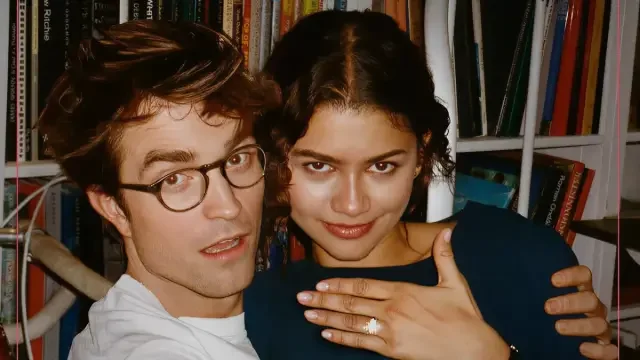
Robert Pattinson and Zendaya star in ‘The Drama’.
Back when the world gave two damns about anything, mass shootings could make the news. I got my start in documentary consumption through Michael Moore, and specifically the jarring crash course that was Bowling for Columbine. I read about Sandy Hook in a Time magazine a few days, maybe weeks, after the debris but by no means the depth of it all had begun to clear. I was home all the time when Virginia Tech happened – when CNN beamed the student’s face, via a terroristic home video, into living rooms around the world.
Before Virginia Tech (I’d maybe heard, abstractly, about goings-on in Oklahoma once) I imagine one could mostly enjoy the convenience of facelessness. Perhaps as an American voter you didn’t necessarily need to confront the reality of just how accessible a semi-automatic weapon was, if you didn’t want to, nor to whom. I’ve wondered ever since what it’s like to be a parent that sends their kid to school one day, maybe even after a breakfast table argument about declining grades; only to receive a call halfway through another day at the office, alleging your child won’t be coming home that afternoon. How unreal it must feel, how unjust, if you’ve never thought even once to point a gun at anything yourself.
I have concerns as to how much of this wonderment Kristoffer Borgli, the director and screenwriter of The Drama, has carried out himself – because it’s not so apparent in this rather hyper-massive cinema event. As far as turkeys go, it’s exceptionally well-stuffed. Robert Pattinson (Charlie) meets Zendaya (Emma) in the sort of big city café with no real charm or character beyond an eternal synth-pop playlist overhead. If this were a novel Borgli would be fluttering rapidly between pages, the way men of poker flick cards, to get to the sauce. A stalker move by Charlie is delightfully excused because he looks like Robert Pattinson wearing someone else’s specs and someone else’s cardigan, and via time lapse there is great sex, dreamy pillow talk, and then there are wedding plans. The sauce: a drinking game with a pair of besties yields the unfortunate truth, hitherto concealed from Charlie, that a young Emma once went 70% of the way towards conducting a mass shooting.
At this juncture you should be excited to encounter a storyteller, in any medium, that’s willing to open this door. Let’s talk about it. Let’s illustrate what sort of motivation it takes to discharge a weapon outside of a warzone. Then let’s talk about how real people have to live with it for the rest of their lives.
I ate an awful lot of popcorn in an usually packed theatre, the evening I saw The Drama. So, my fault, I didn’t immediately understand why my nose wrinkled in the run-up to Emma’s confession; which she expects to be dismissed swiftly for another around because, come on guys, she was a dumb-ass young’n. But also because one bestie (Rachel, played by Alana Haim) has just copped to locking a kid away in an abandoned caravan, and moving on with her life as a toddler because a search party saved the day.
A few scenes prior, Charlie and Emma spot their wedding dance instructor smoking heroin on the street. These little horseshit grenades, with no telling impact on the plot, lead me to ask what will soon become a trademark question on this blog: why must every other A24 movie be full of creatures trying to out-dick one another? Why can’t interplay between characters, and narrative chess, create textured, compelling villains if movie-goers crave them so badly?
The Drama’s second act sees Charlie navigate co-habitation with a woman he now has to worry might still have a mass-killer lurking inside her. The joke appears to be on him. Charlie starts and jumps, and his voice goes up a note or three, because he’s the vessel of ignorance for not understanding where Emma’s volition came from. Borgli feels he has provided us, the audience, with the necessary equipment to both a) laugh at Pattinson’s dilemma, and b) empathise with the terrible coincidences (precipitated by a cruel and unjust American society) that would push someone like Emma so close to the ledge.
That equipment is flashbacks where we witness a young and neglected Emma being bullied at school, stealing her army dad’s gun, and then proving to be so incompetent at plotting any murder that she blows out her eardrum practising in the woods. This over-simplication of a phenomenon that isn’t even historical yet, is almost as gross as Charlie deciding life’s turn justifies him stumbling into an extra-marital affair. I can’t speak to Borgli’s experiences as a person, or what he made of Columbine, Sandy Hook, or Virginia Tech – but he’s shot a movie that’s more interested in keeping the vibes high, rather than investigating, after a quite incendiary revelation.
My movie friends like to ask me what I would have done differently, whenever I do my little Scrooge McDuck thing at the lunch table. Borgli has missed a trick in casting Rachel to the underworld of Karens, a white woman who unattractively exerts moral superiority over a black one. There might have been a real opportunity here for Rachel to try and rationalise her friendship with Emma as Charlie tries to rationalise his imminent marriage to her. For this film, overall, to actually compute what it feels like to pick up a call like the one some folks do, on an otherwise innocuous Wednesday morning.
But, you know, this is where the culture is. (Insert well-meaning shrug here.) Borgli can effectively get away with starting some shit, and freeing us all from dealing with the consequences.