Lately at the Movies

Guillaume Marbeck, Zoey Deutch and Aubry Dullin in Nouvelle Vague.
I believe it’s the Oscars tomorrow. I think I’m in a good place. I have chosen the good fight and kept my Mubi subscription going, despite the many convoluted streaming offers designed to unsettle a convoluted mind. “Here’s three games of basketball every week, just not your Knicks! And here’s every Showtime series ever! – except …” and so on.
I have not fallen asleep at the movies since my little Anora debacle. I had to see Sean Baker’s modern classic three separate times because I was utterly wrecked, for a while, on Friday nights. (It turned out to be one of my very favourite films of the last few years …) Even though I didn’t care much for Sinners, despite the vast amount of historic jam it layers over not (in my opinion) very dynamic storytelling, I want nothing but good things for Ryan Coogler and Michael B. Jordan at the Academy Awards – tomorrow? Tomorrow.
Say what you like and think what you will: my black card is unscuffed, and my Yorck membership is faded the way a good pair of thrifted jeans are.
Jay Kelly.

George Clooney is Jay Kelly.
Back in the day, when I used to write Letterboxd reviews on the train home, I ventured the theory that Noah Baumbach must have recently suffered a concussion – a football hit that has left with him only partial memory of who he actually is. (Or, I suppose, who I need my favourite screenwriter in Hollywood to be.) Some kind of trick of the light is supposed to cast George Clooney squarely in the shoes of fading heartthrob Jay Kelly, who gathers he’s coming to the end of his movie career with nothing much to show for it. Oh, the money’s there, and there’s an eye-rolling daughter, and there are several people managing his time, moisturising his face. But his only true friend in the world might be his agent, no offers are forthcoming from the old limelight, and what public affection remains feels completely artificial.
Kelly comes to these realisations in plush hotel rooms, in the middle of Europe, running through fields. But the whole thing is tinged with such earnest tragedy, and a colourless anxiety for ‘the end’, that I’m wholly convinced Baumbach has forgotten a savage sense of irony is what brought us all here in the first place.
Hamnet.
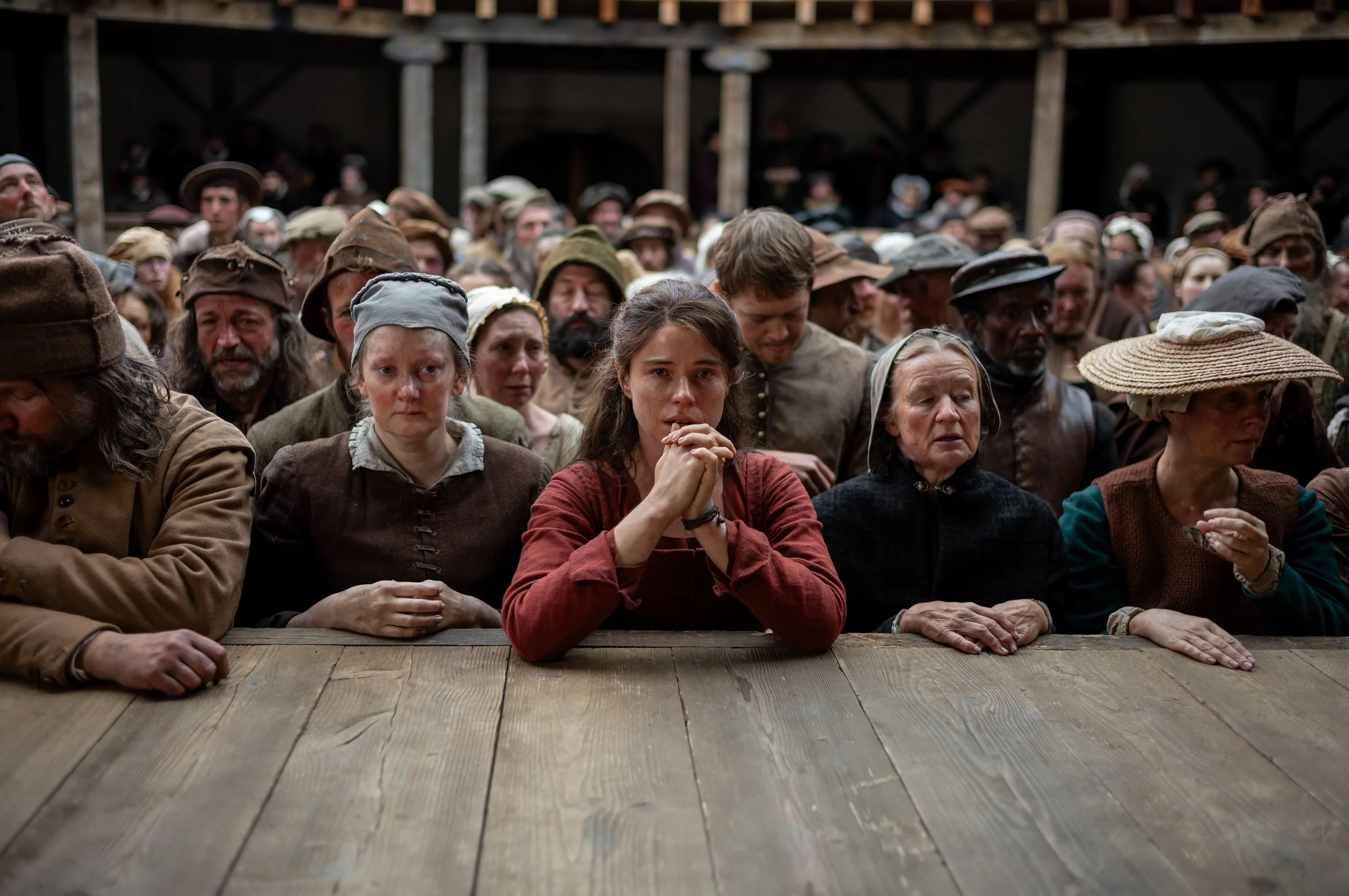
Jessie Buckley is killin’ it, in Hamnet and other things.
Whoever designed my country’s high school English Lit course felt there was no need to formally address who William Shakespeare was. There was some turmoil around the curriculum and reading materials my final year, so I only encountered Romeo & Juliet in the middle of an exam – where I Hail Mary’d the theory that Juliet had likely entertained some lesbian ideation at some juncture. (Your guess how that went.) After just about graduating, I investigated what the big deal was with Shakespeare myself – Hamlet, Macbeth, The Merry Wives of Windsor, a sonnet here, a sonnet there – and much later happened upon The Guardian speculating he might have been gay. (“Knew it!” I might have hollered.) So let’s just say I went into Hamnet open to enlightenment.
I haven’t read Maggie O’ Farrell’s book, for my hunch I still have some work to do. This film adaptation helmed by Chloé Zao leans towards the tragic in a fashion I’m not generally fond of (I believe you all call it ‘tragedy porn’), and barely spares a moment to actually document an ordinary day in the life of old Willie, his son, or the woman he (may have) shared a life with. (She is quite powerfully embodied by the rising star that is Jessie Buckley.) It does all culminate in a heck of a closing set-piece, which (if I’m being fair) is precisely what justified the A-minus grade I gave One Battle After Another.
One Battle After Another.
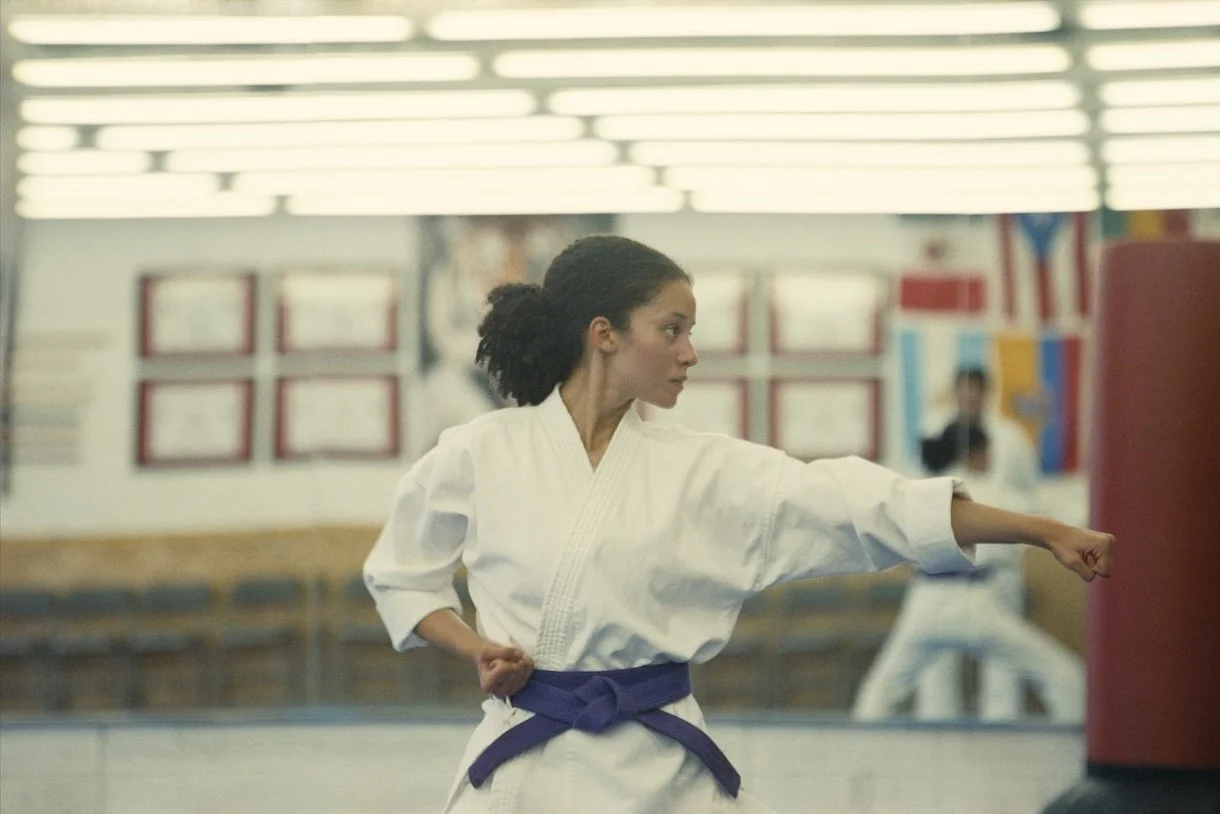
Chase Infiniti more than steals the show, in One Battle After Another.
I encourage you to make time for this conversation, which has (since this movie’s release) been had by lots of other brilliant people. A large number of them take issue with Paul Thomas Anderson’s depiction of a black revolutionary, blaxploitatively named Perfidia Beverly Hills. Perfidia surrenders herself sexually, and her comrades politically, to the whims of a man keen to help cleanse the American race. I personally shift in my sleep, or at least I did yesterday, thinking about this piece, when I considered that Perfidia abandons another white man (haplessly played by Leonardo DiCaprio) in a somewhat misguided quest for agency.
If I am to pause and reason on behalf of the community, I think the problem (blaxploitation play or no) is people don’t feel Anderson (a white director) should be the one to make the observations he does in and around this character. For all the excellence of his filmography there is a distinct gap when it comes to black characters and black stories, which here and now exposes Perfidia’s motivations to serious cultural inquiry. The first thing Anderson might say to all of this, in his counter, is that he lifted these characters from a book by Thomas Pynchon, where none of the main characters are African-American. Whatever the race or background of a character, especially one at the centre of a revolution, they should enjoy the license to seduce whomever they want, betray whomever they want. To fuck up, basically.
The dilemma, however, resides in not making clear for the audience who has all the power in a tryst between an insurgent black woman and a military man who reports to white supremacists. But … Anderson writes a kooky script, full of his trademark apathies; because the teleplay, no matter how complicated, ought be allowed to exist.
I am embarrassed to admit that I was so confounded by this movie, so tossed to and fro in my initial viewing, that almost none of this occurred to me as a potential crisis in the Humanities. I was ready to walk out of the theatre thinking this was the weirdest and most inexplicable PTA flick I’d ever seen, for how everybody’s just flung around from scene to scene. Then he shot one of the best third acts I’ve ever seen, a technical tour-de-force, wherein another black woman uses bare minimum competence in combat to kick an awful lot of ass.
One Battle After Another is a fitting reflection of the world we live in, of the conversations we have out in the open and also when no one’s looking. However much of that we each think reflects the world Paul Thomas Anderson lives in … well.
Marty Supreme.
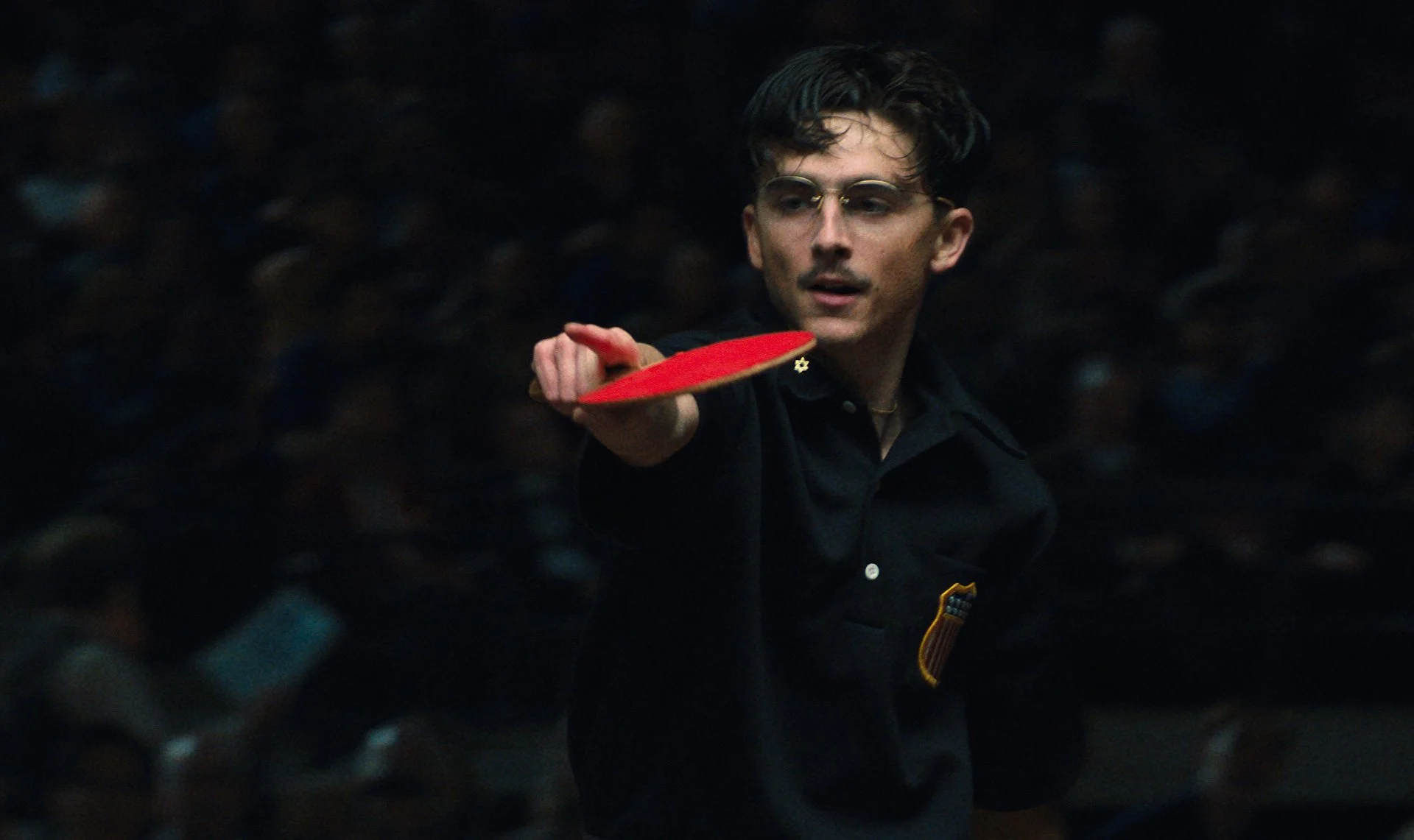
Timothée Chalamet, for better or worse, is Marty Mauser.
I’m the only person I know that quite enjoyed Benny Safdie’s The Smashing Machine. It reaches for butterflies in moments absolutely wrought with interpersonal turmoil, let alone the killing fields of mixed martial arts. I thought, hey, maybe this Safdie bros creative divorce will be good for everybody, and for film-lovers especially.
Sadly, Timotheé Chalamet’s season-long press tour is (for me) going to be much more memorable than almost anything in Josh Safdie’s solo directorial debut. Nearly every minute of this strange and very late homage to men behaving badly is a trinket laid upon the altar of Marty Mauser, a decent ping-pong player we must acknowledge in the bagel store … just because he will (yawn) pursue greatness at any cost. He’ll have sex with someone else’s partner on the job, at the job. He’ll clean out your cash register, with a gun, in the way of swift resignation. He’ll break glass, leap out of windows, steal shit, just because it looks good on camera and to one Safdie justifies two hours plus at the movies.
Safdie isn’t remotely interested in showing us a real person affecting the lives of real people, or in resolving real and obvious conflict between Marty’s endless side-quest and all the lives that enable it: that of the woman he impregnates and tries to abandon, the terrible man he cuckolds, the other terrible man he cuckolds, and so on. What makes this non-plot doubly frustrating is Safdie has – in Chalamet and particularly Rachel Mizler – two of the most exciting actors in the game giving this matinee literally everything they’ve got. But fucking Marty, on lead vocals, can’t help drowning out the band.
When literally the entire movie diverges to explore a sub-plot with a missing dog, and literal bodies pile up, it’s genuinely exasperating. This Safdie bro comes off like a new and rather annoying roommate: you keep giving him the house rules, and he keeps ignoring them because oh, shit, my bad, man – just got caught up again making some art.
Nouvelle Vague.

Zoey Deutch and Guillaume Marbeck hold it together, in Nouvelle Vague.
I am ready to divest all my Noah Baumbach stock – if this Jay Kelly business is just the way it is now – towards a fund of Richard Linklater’s choosing. I missed the one about Steve Carrell as a war veteran, and let’s not mention that Glen Powell one, but there are almost no misses in his glittering CV. Linklater passes the existential test: I think about Boyhood, Everybody Wants Some, and Dazed & Confused all the time.
I might not think about Nouvelle Vague all the time but that’s not going to be a quality thing. This pinãta is packed with treats – various luminaries of French film, including François Truffaut, briefly populate this cheeky diary of time wasted on the freestyling set of a Jean Luc Godard production; right at the cusp of the birth of the New Wave. Linklater and I (and Baumbach) appear to like the same things – the way in French movies every conversation is one quip away from becoming a colourful argument, and how everyone (even the grip, even the runner) believes they’re God’s gift to style. I mention the grip, and the runner, because Linklater is determined to show you how many people a gifted director must drive crazy to shoot a classic.
At times this can be overwhelming (the first 45 minutes of Nouvelle Vague are full of wham-bam introductions), but the film benefits from eventually centering itself on Godard’s eccentricities, Jean Seberg’s delightfully clunky, Midwestern French, and a producer with no more hair to pull off his head. Whether the core comedic device works – Godard existing and operating in his own luxurious shadow universe – in a movie this long … I think I’ll only be able to discern after five more viewings.