Dear Industry!
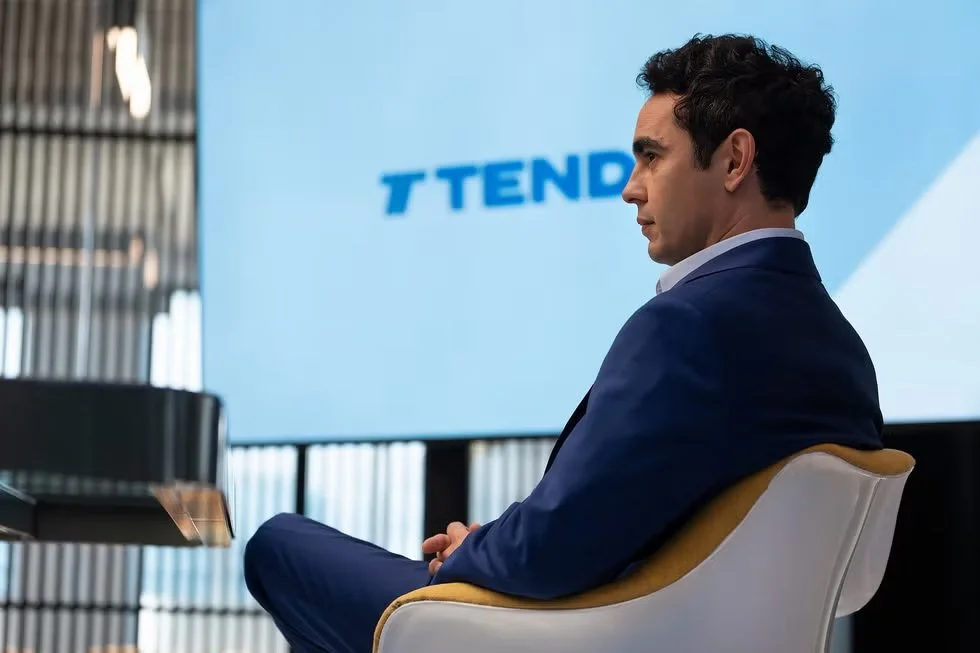
Max Minghella is Whitney Halberstram, in the 4th season of HBO’s Industry.
Dear Henry – do you ever fire up a record by a beloved band, concede that time and business hath finally wrought their voodoo, but still take away three songs that hint at the old magic? Three songs, even one, that promise another tier of greatness to come?
When I consider this fourth season of Industry, what sort of pie we have after each fresh, episodic slice, I can’t help but think of Emre Belözoğlu: a Turkish footballer who in the early oughts gave me (at least) reason to follow a quite disastrous Newcastle United side. He was slight in stature and slight in movement, a player who could achieve astonishing grace with touches as quick and subtle as the deftest turns of phrase. The Toon lost a lot of games but I always turned away thinking, Well. At least I got to see that feller do his little magic tricks.
This is Industry season 4: a ferocious rock album that more often than not has produced hella bark to compensate for little bite – but that has now, with its sixth episode, turned a kaleidoscopic collection of scrappy draws and inexplicable away defeats into peak TV. To close the football metaphor, the dropped points have been absolutely worth it – because they’ve culminated in yet another statement piece for HBO, and underlined the exact genius of creators Mickey Down and Konrad Kay. Industry is a show about how people swear and claw and bleed all around and all over the numbers, only to squander the wins by also transacting in the volatile currency of the 11th hour.
Despite taking the bait of what it takes to engage an audience in 2026 – the overlap between extreme wealth and unchecked hedonism, and therefore near-constant fencing with dicks on Zoom calls – Industry has to its credit resisted some standard industry temptations. Familiar faces have been jettisoned, so that main character arcs can I suppose thunder into new frontiers unburdened by prior sins. (Even PierPoint, the series’ central banking institution, is but a footnote in the brave new world of undercooked digital finance.)
Though Industry ever so lightly touches on the IRL foibles of the day, Down and Kay (and co!) make abundantly clear they’re still above (or giddily beneath) moralising through their characters. Here is a callous world. Here are the carnivores who subsist within its rules and norms. Here are its disruptors. Okay, I lied, maybe there’s one more football metaphor in all of that: the ball doesn’t care who the ‘good’ or ‘bad’ guys are, which makes Industry’s narrative as precarious and tense as a well-poised semi-final. It could almost be happening live.
The great disruptor of season 4 is a mysterious young man named Whitney Halberstram. He speaks in dream-like cadence (husky, too clean, and often just above the register of audibility) about Tender, the digital banking service Whitney has hauled by the scruff of its neck to the centre of the financial cinematic universe. Thereabouts an existential threat looms over questions about Tender’s reporting of its transactions, growth, and assets. Stern Tao – a shiny new hedge fund peopled by old, vengeful friends – is betting everything on Tender’s house of cards eventually collapsing.
Up until this episode, Whitney has only provided the rest of the cast, and therefore us, with cursory, possibly dubious insight into who he is: a gamer capitalism never saved a seat for, but who has finagled timing and wit into market relevance. Who doesn’t love an underdog that can help the tournament pretend the system isn’t rigged. This sixth episode uses a whistle-blowing incident to symphonic effect, placing Whitney on the shrill end of a reckoning and building his character with that evergreen adage: You don’t really know a person til you call bullshit on their earnings report.
Hitherto Kit Harington has carried the show on his shoulders with the sword of extraordinary range, staggering from very poor decisions as child of society Henry Muck into gameday gravitas as Tender’s privately misguided but publicly visionary new CEO. Via voiceover, Max Minghella’s Whitney narrates a series of urgent, likely unsent letters to Henry – muddling the proximity of absolute victory in the markets with the tragedy of hopeless longing. I thought of ‘The Summer Man’ watching this, the Mad Men episode in which Don Draper ruminates and narrates out loud from a journal. The device works better here, because it offers some degree of insight into Whitney whilst depriving us of meaningful conclusion. He writes about the value of time, the irrelevance of self, whilst floundering for a return leg in a raging battle with Stern Tao. In less than one hour Industry manages to shift the balance of power, twice, thrice, and conduct a poetic character study, set against a montage of a warzone that doesn’t stop moving.
Hijacking Stern Tao’s lunch meeting with a whistleblower, Whitney pleads ‘reason’ with yet more hyper-inflation. “Look at you,” he says, projecting false calm. “You’re wavering at the gates of Valhalla.” What probably shouldn’t work on the page, just because it’s so dense with chocolate, speaks to the kingdoms in the sky that men like Whitney habitually promise romantic partners, stock markets, governments. Where else, I wonder, have we heard such superfluous world-building?
We may be in the final days of HBO, the last factory capable of mining so much gleaming ore from odd planets with some might say classical, others might say antiquated instruments. I’m doing my best to savour every last voyage.